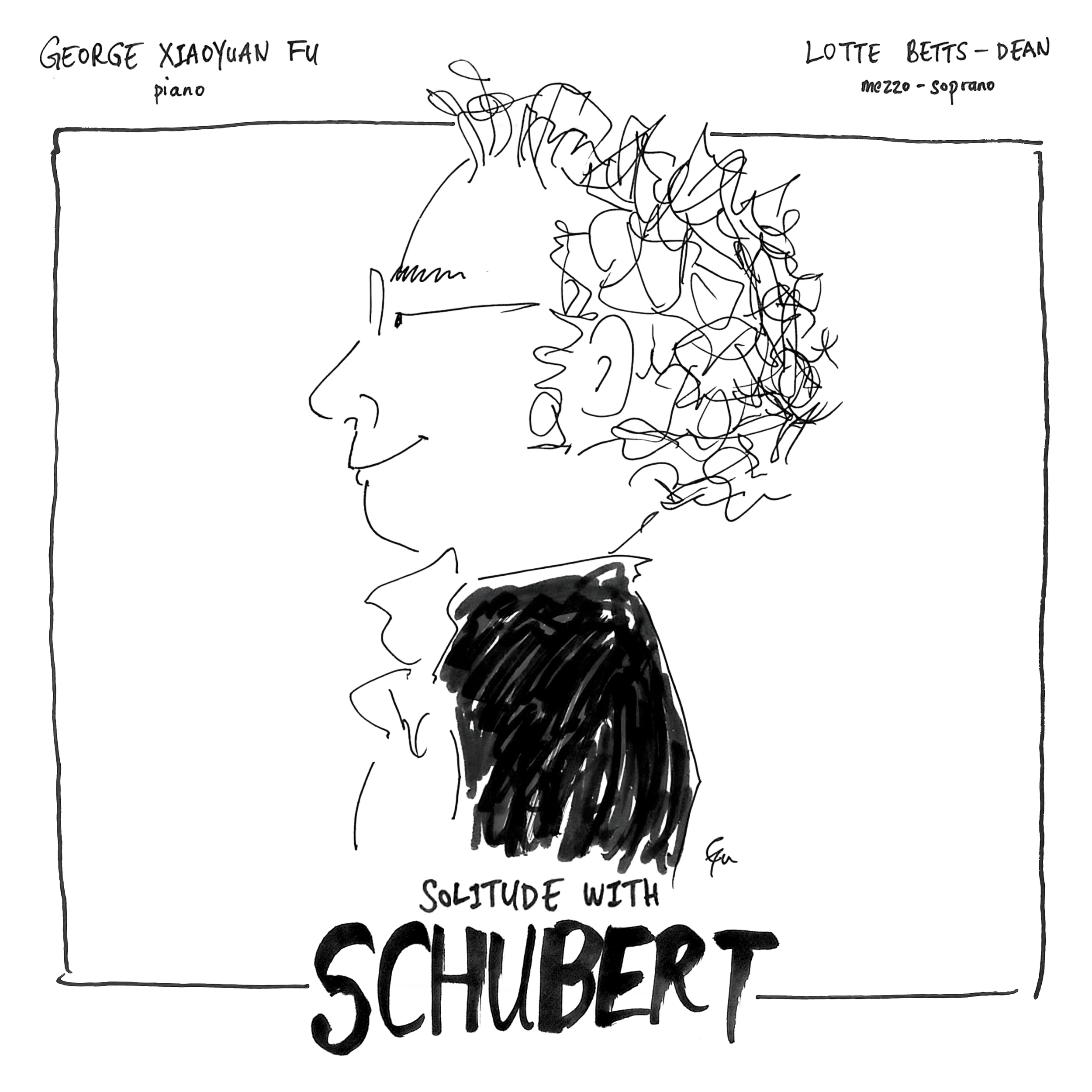
Solitude with Schubert
Platoon, July 10, 2026
Gramophone Magazine Editor’s Choice
A Schubertiade featuring solo piano works and Lieder with Lotte Betts-Dean. Featuring the Sonata in c minor D. 958, Einsamkeit D. 620, as well as the Allegretto in c minor D. 915, the Hungarian Melody D. 817, and extracts from Schwanengesang D. 957.
Gramophone: From the opening Allegretto in C minor, D915, taken at a tempo that recalls Richter’s capacity for making time itself seem to hesitate, the voicing is warm and attentive; harmonies overlap through imaginative pedalling, as if thoughts are interrupting one another before they have quite finished speaking.
The C minor Sonata is the centre of gravity of the album. Fu understands that Schubert’s drama often emerges from the coexistence of contradictory ecosystems. Fragility and force occupy the same space. The first movement’s development section sounds genuinely dangerous, its scales threatening to tear the fabric of the music apart; yet the architecture never disappears entirely from view. The Adagio is dark, sustained and haunted by a Winterreise-like awareness of ever-approaching doom. Throughout, Fu makes silence an active participant in the conversation. The finale’s tarantella-like onrush has all the necessary urgency despite a slightly more measured tempo than Andsnes’s. This is less a maniacal dance than an ‘Erlkönig’ ride: the horse gallops, shadows flicker, danger gathers at the edge of vision…
In the great ‘Einsamkeit’, singer and pianist arrive at something genuinely special. The song unfolds almost as a Schubertian theatre of memory, passing through successive states of being with a breadth that recalls Shakespeare’s Seven Ages of Man. Betts-Dean’s timbre, particularly when the vibrato recedes, possesses a vulnerable, almost boyish quality that lends the song a poignant fragility. Words matter here. Every phrase feels weighed, considered and lived…
The closing Hungarian Melody leaves us suspended between consolation and regret. It is an apt ending. Fu’s recital is not really about solitude in the modern sense, with its implications of alienation. It is about the older Schubertian variety: an evening drawing to a close, friends departing, candles guttering, and the peculiar warmth left behind by melancholy when it has found exactly the right music in which to dwell. -Michelle Assay
BBC Music Magazine: While Beethoven reaches out to his ‘distant beloved’, Schubert – after a hint of dalliance – eventually settles for aloneness. For all that, it can sound rather like a romantic sermon, but Lotte Betts-dean persuasively stresses the intimate, confessional, sometimes almost fragile side of this original song sequence… It fits well with George Xiaoyuan Fu’s idea of the disc as a ‘Schubertiade’, one of those small-scale gatherings where Schubert played his music to friends. It’s easy to imagine such an event beginning with the Allegretto in C minor, which in Fu’s hands is full of subtle but compelling poetry, with just enough of that echt-schubertian quirkiness to prevent it from sounding entirely safe – even here, romanticism isn’t quite tamed. But what would even Schubert’s closest friends have made of the C minor Sonata, one of the most weirdly visionary products of his last year? (There’s no evidence that anyone even heard it in his lifetime.) Fu’s performance is lyrically beguiling and alive to the mercurial emotional nature of the music. -Stephen Johnson
The Arts Desk: Schubert’s late piano sonatas can sprawl and feel unwieldy, but this performance of No. 19 in C minor feels like a single take. The long “Adagio” has a Brucknerian sweep and the tarantella finale (“an unruly beast”) is a beguiling mixture of bleakness and exhilaration, Fu slamming the door shut with the final C minor chord… Soprano Lotte Betts-Dean joins Fu for two numbers from Schwanengesang, the piano’s burbling accompaniment in “Liebesbotschaft” one of the loveliest things on this album. Betts-Dean is marvellous throughout, warm-toned and intensely communicative; her "Die Taubenpost" has an irresistible lilt. The six sections of Einsamkeit enthral here, the narrator’s opening request for peace and solitude set to music of spare beauty, Fu and Betts-Dean sounding as one. Each verse’s distinct mood is perfectly characterised, the restless piano writing at the start of the second section brilliantly played. -Graham Rickson

Colouring Book
Platoon, March 28, 2025
Gramophone Award Winner 2025
Gramophone Magazine Editor’s Choice
Gramophone Magazine Best Albums of 2025
In Colouring Book the etude is presented as a vehicle for creative innovation and exploration. The album features Claude Debussy’s complete 12 Études, alongside Études by contemporary composers Matthew Aucoin and Ninfea Cruttwell-Reade, as well as my own passacaglia on a theme by Radiohead.
Gramophone: You don’t have to know the Radiohead original to appreciate Fu’s ingeniously busy yet never cluttered polyrhythmic aplomb, or revel in the unpredictable variety from variation to variation. Needless to say, Fu plays his own music with tremendous authority and colouristic resources, as he also does with the Cruttwell-Reade and Aucoin selections… As for the Debussy Études, Fu’s recordings contain some of the most enchantingly characterised interpretations I’ve heard since those of Ju-Ying Song, Florent Boffard, Mitsuko Uchida and Jean-Efflam Bavouzet. Yes, they’re that good! -Jed Distler
International Piano Magazine: British composer Ninfea Cruttwell-Reade’s Three Etudes for Piano and Flower Pots (2019), which employs nine flower pots of various sizes filled with water to create a scale, is an aural delight. Together, Fu and percussionist James Larter create atmospheres of astonishing variety and subtlety. The American composer Matthew Aucoin wrote his Three Études for Fu in 2014. In the composer’s words, they are not studies ‘of particular pianistic challenges, but rather studies of certain forms of musical motion’. That said, they pose challenges that Fu meets with considerable virtuosity. Fu’s own Passacaglia on a Theme by Radiohead (2020) uses as its basis the first cut of Radiohead’s album ‘OK Computer’. At over eight minutes, it is the longest piece on the programme and extremely effective.
As Fu points out in his booklet notes, sketches for Debussy’s Études date from the time he was preparing a new critical edition of Chopin’s Études for Durand. Most striking in Fu’s interpretations are his expert realisations of Debussy’s plasticity of tempos: tempo giusto where required, the perfect rubato when indicated, and the transitions between them are flawless. Add to this his wide and infinitely calibrated spectrum of dynamics and of touch, not to mention an ineffably ‘French’ approach, and you have some of the elements that make these performances so successful. -Patrick Rucker
BBC Music Magazine: This is an artist who unites seriousness with playfulness, intellectual curiosity and imagination. And so it proves in his playing.
…His refreshing programme is framed by the two books of Debussy’s dozen Études… Fu makes them sound as if they had just been written, his playing clean and crisp, never overstated but often marvellous… The contemporary numbers make for a fresh twist. -Rebecca Franks
AllMusic: The centerpiece of this 2025 release by the rising pianist George Xiaoyuan Fu is the set of 12 etudes by Debussy… There are plenty of recordings of these, but this one is a standout… They need a pianist who can find the humor, as well as one who can deliver the virtuoso passages in flowing style, and here, they find both. It is a performance that is light, expert, and absolutely delightful… As an entr'acte between the two etude books, Fu offers contemporary compositions, one of which he wrote himself; his Passacaglia on a Theme by Radiohead (the source is Airbag, from the album OK Computer) intelligently picks a song that would work in this treatment, and the Three Etudes for Piano and Flower Pots (they're played with mallets of some kind) of Ninfea Cruttwell-Read are very much in the Debussy spirit. The Three Etudes of Matthew Aucoin are more of the Chopin type, referring less to the classical practice function of the etude, but they are full of unexpected twists and turns. -James Manheim

TRIO ZIMBALIST: Piano Trios of Weinberg, Auerbach, & Dvořák
Curtis Studio, January 12, 2024
Gramophone Magazine Editor’s Choice
Trio Zimbalist’s debut album of piano trios by Mieczyslaw Weinberg, Lera Auerbach, and Antonín Dvořák is cast in the spirit of the Dumka, containing works composed under the shadows of troubled and traumatic political histories.

Photo: Raphael Neal
MIRRORS
Platoon, November 11, 2022
2024 BBC Music Magazine Newcomer Award Winner
Works by Andres, Chin, Dutilleux, Ravel, Rachmaninov, Tailleferre, Waley-Cohen
BBC Music Magazine: Ravel’s Miroirs is the starting point for this keyboard essay, and it’s all rather breathtaking. Fu’s approach is intelligent but fuelled by a deep emotion and understanding of the repertoire (here both old and new); his touch on the keys is barely apparent in the Ravel, with the music flowing gossamer-like.
International Piano Magazine: Each movement of Ravel’s epoch defining Miroirs finds an echo in later pieces. Interleaving the music in this way offers an enhanced appreciation of Ravel’s importance in the musical continuum. For example, a beautiful performance of ‘Noctuelles’ and a haunting ‘Oiseaux tristes’ are followed by the Dutilleux prelude ‘Le jeu des contraires’, which prolongs the atmosphere while emphasising retrogrades and inversions… Chin’s Ligeti-influenced Etude is a fiery toccata, rendered here with supreme confidence… Fu’s fluent and nuanced ‘Barque’ is one of the finest available, his ‘Alborada’ joyous.
Gramophone: Musicality and intelligence govern George Xiaoyuan Fu’s programming agenda, resulting in a genuinely interesting rather than gimmicky playlist… Fu’s precise fingerwork cannot be faulted, and his gift for programme-building deserves serious attention.